

From market signals to financing strategies and upgrading decisions, explore curated learning to help you buy, sell, or invest with clarity and confidence.
From market signals to financing strategies and upgrading decisions, explore curated learning to help you buy, sell, or invest with clarity and confidence.
Recent Hot Topics Singaporeans Care About
How We Help You Learn
Our education ecosystem spans seminars, articles, market insights, tools, and data-driven frameworks to help every homeowner and investor make smarter decisions.
Start with our latest guides, insights, and explainers. Updated regularly to help you decode the Singapore property market.





Curated Content Just For You to Stay Ahead

Should You Still Stretch for a Bigger Home in the AI Era?
TL;DR AI does not have to take your job to affect how comfortable your mortgage feels. A role change, career transition or compensation reset could alter the income supporting a 20- to 30-year loan, which is why today's maximum borrowing capacity should not automatically become your property budget. AI is changing jobs more than eliminating them: Singapore's evidence so far points more towards job redesign and new AI-related roles than widespread headcount reductions, but that can still mean changes to responsibilities, skills and career paths. Your mortgage stays fixed while income can change: A loan that feels manageable on two strong salaries can become considerably heavier after a pay reduction, weaker bonuses or a temporary period on one income. Bank approval cannot predict your future career: TDSR already stress-tests interest rates and variable income, but it cannot determine whether today's fixed salary will still look the same five or ten years from now. Stress-test your career, not just interest rates: Ask whether the mortgage still works if household income falls 20%, bonuses disappear, one partner needs six months between jobs or retraining temporarily reduces earnings. Unused borrowing capacity can buy flexibility: Choosing a smaller mortgage may preserve cash, CPF and the ability to navigate a career transition without immediately putting the home under financial pressure. Bottom line: AI is not a reason to avoid buying the bigger home. It is a reason to ask a harder affordability question: Will this home still work if your career does not go exactly according to plan? You are 40, earning more than you did five years ago.Your career looks stable. Your spouse is working too. Your current home has appreciated, and the children could certainly use another bedroom.Then the bank tells you how much you can borrow.Suddenly, the bigger condominium you thought was slightly out of reach looks possible.The natural reaction?If the bank says we can afford it, why not stretch a little more?For years, that calculation may have felt reasonable, particularly for mid-career professionals expecting their income to remain stable or continue rising.But artificial intelligence is one more reason to examine an assumption sitting quietly behind that decision.Not necessarily whether you will still have a job.But whether your income five or ten years from now will follow the path you expect it to today.That matters when the financial commitment you are considering could last 20 to 30 years. What we'll discuss: AI Does Not Have to Take Your Job to Affect Your Mortgage A Bigger Mortgage Is Also a Bet on Your Future Salary The Bank Tests Today's Income. Your Mortgage Lives in Tomorrow's Economy. Your Job Title May Survive. But Will Your Earning Power? This Is Why Mid-Career Buyers Face a Different Risk So Instead of Stress-Testing Only Interest Rates, Stress-Test Your Career Your Emergency Fund Is Also Career Flexibility What If You Deliberately Bought Less Than You Qualified For? Does That Mean AI Should Stop You From Buying the Bigger Home? The Question Is No Longer Just "Can I Afford It Today?" AI Does Not Have to Take Your Job to Affect Your Mortgage Much of the conversation around AI and employment tends to swing between two extremes.One says AI is going to replace huge numbers of workers.The other says AI will simply make everyone more productive.Singapore's experience so far appears more nuanced.In April 2026, the Ministry of Manpower (MOM) reported that 28.5% of firms had adopted AI in some form. Among those firms, only 6.2% reported reducing headcount.Far more were changing the work itself.About 18.9% had redesigned job functions, while 13.9% had created new AI-related roles.AI adoption was also particularly high in sectors containing many PMET roles: Sector Firms Adopting AI Information & Communications 74.1% Professional Services 57.5% Financial & Insurance Services 56.4% Source: MOM, stats.mom.gov.sgMOM's conclusion was not that AI was causing widespread unemployment. Rather, its effects were appearing more strongly in how jobs are being redesigned than in jobs disappearing altogether.For a homeowner, that distinction is important.Because you do not have to become unemployed for a large mortgage to become uncomfortable.Your role could change.Your company could restructure.Your next position could come with a different compensation package.You could spend several months transitioning between roles.You might decide that staying employable requires retraining or moving into a different function.Or a portion of your pay that once felt dependable, such as bonuses or variable compensation, could become less certain.For a long-term borrower, the more useful scenario to test is therefore not simply whether AI eliminates the job, but whether a role change, transition or compensation reset could interrupt the income path the household had assumed.And that is where the property question becomes interesting.A Bigger Mortgage Is Also a Bet on Your Future Salary When buyers think about upgrading, the focus is usually on the property.Can we afford the downpayment?How much can we borrow?What will the monthly instalment be?Can we stretch another $200,000 for the larger unit?But underneath all those questions sits another assumption:that your future earning power will continue supporting today's property decision.Suppose a couple earns a combined gross income of $20,000 a month.Based on their current finances, they are considering taking a $1.5 million housing loan over 30 years.At an illustrative interest rate of 3%, their monthly mortgage would be approximately $6,300.At today's income:$6,300 $20,000 = about 32% of gross household income.That might feel manageable.But imagine their combined income falls by 20% after one partner goes through a career transition.Their mortgage has not changed.Their property has not changed.But now:$6,300 $16,000 = about 39% of gross household income.If the household temporarily relies on a single $10,000 income, the same mortgage consumes approximately 63% of gross income. Scenario Gross Household Income Illustrative Mortgage Mortgage as % of Income Current income $20,000 $6,300 32% Income falls 20% $16,000 $6,300 39% Temporary single income $10,000 $6,300 63% Illustrative example only. It excludes other debts, expenses, CPF usage and individual financial circumstances.Nothing happened to the mortgage.What changed was the income supporting it.That is the part of affordability an approval letter cannot predict.The Bank Tests Today's Income. Your Mortgage Lives in Tomorrow's Economy. Singapore's Total Debt Servicing Ratio, or TDSR, requires a borrower's total monthly debt obligations to stay within 55% of gross monthly income.It is an important safeguard against excessive borrowing.That safeguard is more conservative than the headline 55% suggests.For residential property loans granted by financial institutions, the TDSR calculation uses the higher of the loan's thereafter interest rate or a 4% medium-term interest-rate floor. This means a borrower may be assessed at a higher rate than the promotional mortgage rate actually being offered.Variable income such as bonuses, commissions and allowances is also subject to a minimum 30% haircut when calculating TDSR. In other words, only part of income considered less dependable is recognised for the affordability test.So the framework already builds in protection against higher rates and fluctuating income.But there is still something it cannot determine.Whether the fixed salary feeding that calculation will look the same five or ten years later.That is the distinction.TDSR can stress-test the financing assumptions available today.It cannot tell you what your profession, employer or earning path will look like eight years from now.CPF Board similarly advises buyers to think beyond the maximum loan available, factoring in job stability, future expenses and potential income changes when deciding what is genuinely affordable.That becomes relevant when industries themselves are changing.In June 2026, Shopee cut jobs in Singapore, with software engineers among those affected, as parent company Sea continued investing in AI.Importantly, Shopee did not say those employees were directly replaced by AI. The company said departments may adjust staffing based on operational and business priorities following regular reviews of business operations.So it would be inaccurate to conclude that AI simply "took their jobs".But the episode illustrates something more relevant to a long-term borrower:Even highly skilled, seemingly secure white-collar roles can be affected as companies reorganise around changing technology and business priorities.That does not make those careers unsafe.It does make it harder to assume that the way a role looks today will remain unchanged throughout a multi-decade mortgage.Your Job Title May Survive. But Will Your Earning Power? This may be the more useful AI question for someone considering a larger home.Imagine your job still exists five years from now.That does not necessarily mean the economics of the job remain identical.If AI allows a team to produce more with fewer manual processes, companies may reorganise responsibilities even without eliminating an entire occupation.Some employees may become considerably more productive and valuable.Others may find certain tasks automated or redistributed.New roles may emerge.Old responsibilities may disappear.And the skills employers value most may change.MOM's findings already point towards this process. Firms adopting AI have so far been more likely to redesign jobs or create new AI-related roles than to reduce headcount.NTUC has raised similar concerns around adaptation.Ahead of Budget 2026, it called for stronger transition support for PMEs as AI reshapes workplaces and employer expectations. Its Survey on Economic Sentiments 2025 found that 56% of PMEs felt they needed to upskill to remain relevant.That does not mean those workers will lose their jobs.Nor does MOM's evidence establish that AI is already reducing PMET salaries or long-term earning power.What it does show is that work is changing.For a 38-year-old considering a 25-year mortgage, that is worth accounting for.You are not only asking whether you will remain employed.You are asking whether your household finances have enough room to absorb the career transitions that could occur over the life of the loan. Enjoying our insights so far? Stay updated with the latest property trends, expert analysis, and market perspectives from PropNex. Join our mailing list This Is Why Mid-Career Buyers Face a Different Risk Someone in their late 30s or 40s may actually be in their strongest financial position yet.Your salary may be near its career high.You may have built substantial CPF savings.Your first property may have appreciated.Your borrowing capacity could be significantly greater than it was ten years ago.Which makes stretching for the bigger home especially tempting.But this life stage can also come with heavier financial commitments.Children.Parents.Insurance.Retirement.Education costs.Perhaps even plans to slow down professionally later in life.At the same time, you have fewer working years available to recover from a major financial setback than someone buying at 28.That means your maximum borrowing capacity and your sensible borrowing capacity may not necessarily be the same number.AI does not create that risk.But it gives buyers another reason to think seriously about the gap between the two.So Instead of Stress-Testing Only Interest Rates, Stress-Test Your Career Most buyers know to consider what happens if mortgage rates rise.In the AI era, it may also be worth asking what happens if your income changes.Before committing to the upgrade, try running the property through several different versions of your career.Test 1: What if household income falls by 20%?Do not assume retrenchment.Perhaps one partner moves into a different function after a restructuring and accepts a lower salary.Perhaps variable compensation falls.Perhaps a new role trades income for greater stability.Would the property still feel comfortable?More importantly, could you continue saving for retirement and other goals after paying the mortgage?Test 2: What if your bonus disappears?For some PMET households, bonuses quietly subsidise their lifestyle.Holidays, enrichment classes, investments, renovations and annual expenses may all depend on them.This is also why TDSR does not treat variable income in the same way as fixed salary.Try applying the same conservatism to your own property budget.If your mortgage only feels comfortable because you expect a strong annual bonus, ask whether that income should really support a 25-year commitment.Test 3: What if one person needs six months to transition?AI-related restructuring does not have to mean permanent unemployment.The problem may simply be the gap between roles.Could one income temporarily support:the mortgage;household expenses;insurance;children's expenses;support for parents; andother debt commitments?If not, how much cash would you need to bridge that period?Test 4: What if you need to retrain?A career transition can involve more than lost salary.You may choose to spend time acquiring new skills.You could temporarily accept less demanding work.You might move from a mature function into a growing one and take time to rebuild seniority.That flexibility is easier to exercise when your household does not require every dollar of your current salary simply to maintain the home.Your Emergency Fund Is Also Career Flexibility This is where the property decision and AI conversation connect most directly.A cash buffer is normally described as protection against emergencies.But for a mid-career worker navigating technological change, it can also buy time.Time to search for the right next role.Time to reskill.Time to avoid accepting the first job available simply because next month's mortgage is approaching.CPF Board recommends maintaining three to six months of expenses for emergencies and suggests retaining some Ordinary Account savings as a housing safety buffer.For a PMET working in a rapidly changing industry, that raises an important question before upgrading:After completing the purchase, how much flexibility will actually remain?If almost all your cash and CPF resources are required to make the upgrade work, then the home may be affordable under today's employment conditions but less resilient if those conditions change.What If You Deliberately Bought Less Than You Qualified For? This runs against how many people naturally approach property.Once buyers discover they qualify for a certain loan quantum, that amount often becomes their new property budget.If you can borrow $1.5 million, you start viewing homes that require something close to a $1.5 million loan.Otherwise, it can feel like you are "wasting" your borrowing power.But consider turning the logic around.What if maximum borrowing capacity is a ceiling rather than a target?Suppose a household qualifies for a $1.5 million loan but chooses a property requiring only $1.2 million.That difference could mean:lower monthly repayments;more cash preserved after completion;less dependence on bonuses;more CPF left for retirement;greater ability to survive a career transition;more freedom to retrain or change industries;less pressure to immediately replace a lost salary; andless likelihood of needing to sell the property at an unfavourable time.The trade-off might be a smaller unit.A different location.An older development.Or simply postponing the next upgrade.That can feel like settling.But there is another way to view it.You are purchasing financial flexibility alongside the property.And in an economy where the value of different skills can change quickly, flexibility itself becomes an asset.But that flexibility is not free.If both careers progress as expected and the larger home appreciates, buying less could mean giving up some asset growth. If the family later needs to upgrade anyway, it could also mean another round of transaction, moving and renovation costs.So the argument for leaving borrowing capacity unused is not that it will necessarily produce the better financial return.It is that the two mistakes can have very different consequences.Under-buy, and you may have to upgrade later.Overstretch and suffer an income shock, and you may be forced to sell when the market, your Seller's Stamp Duty position or your personal circumstances give you very little negotiating room.That is the asymmetry worth thinking about.You may never need the additional financial buffer.But if you do, its value could be far greater than it appeared on the day you chose the smaller mortgage.Does That Mean AI Should Stop You From Buying the Bigger Home? No.That would be an overreaction to what the current evidence actually shows.Singapore has not experienced broad-based AI-driven job displacement.And the wider labour market is not signalling a white-collar employment crisis either.In March 2026, resident unemployment stood at 2.9%. There were still 1.46 job vacancies for every unemployed person, while the six-month re-entry rate among retrenched residents rose to 60.7%, with improvements seen among PMETs and degree holders.More recent MOM statements have also continued to emphasise that firms adopting AI are, so far, more commonly redesigning jobs and creating roles than reducing headcount.AI may make many workers more productive, create new opportunities and increase the value of people who learn how to use it effectively.So the lesson is not:AI is coming. Buy a cheaper home.It is:AI is one more reason not to assume that today's role, salary structure and career path will remain unchanged for the next two decades.Your housing decision should be able to tolerate some uncertainty around that path.There will still be households where stretching makes sense.Perhaps both incomes come from different sectors.Perhaps the mortgage remains manageable on one salary.Perhaps substantial cash reserves remain untouched after the purchase.Perhaps there are few other financial commitments.Or perhaps the larger home meets a genuine long-term family need that justifies the higher cost.The question is not whether stretching is automatically wrong.It is whether you understand what has to continue going right for that larger mortgage to remain comfortable.The Question Is No Longer Just "Can I Afford It Today?" For years, career progression made one property assumption especially comfortable.Earn more.Upgrade.Earn more again.Upgrade again.For many people, that progression may still happen.But AI is introducing another variable into the equation.Jobs may remain while tasks change.Roles may survive while the skills required to perform them evolve.Entire professions may not disappear, but individual workers could still experience periods of disruption as companies restructure around new technology.That means a property buyer today may need to think beyond current affordability.Your bank can tell you how much home today's salary allows you to finance.But a 25-year mortgage will live through far more than today's salary.In the AI era, the strongest property decision may therefore not be buying the biggest home you qualify for.It may be buying the home that still works even when your career does not go exactly according to plan. Views expressed in this article belong to the writer(s) and do not reflect PropNex's position. No part of this content may be reproduced, distributed, transmitted, displayed, published, or broadcast in any form or by any means without the prior written consent of PropNex. For permission to use, reproduce, or distribute any content, please contact the Corporate Communications department. PropNex reserves the right to modify or update this disclaimer at any time without prior notice.
Read More
Why A Rising Private Market Can Raise Your HDB-To-Condo Upgrade Bill
TL;DR A rising HDB value does not automatically make upgrading to a condo easier. What matters is the gap between what you can actually take from your flat sale and what you need for the next property. Your sale proceeds are not your full gain: The outstanding housing loan must be redeemed, while CPF principal used and accrued interest are returned to your CPF account. The amount left for your next purchase may therefore be less than the headline selling price suggests. The upgrade gap matters more: If the condo you want has become more expensive faster than your HDB has appreciated, you could still face a larger top-up even though your flat has gained value. Different segments move differently: HDB resale prices fell 0.1% in 1Q2026 and 0.3% in 2Q2026, while private residential prices rose 0.9% and 0.5% respectively. But CCR, RCR and OCR condos did not all follow the same path. Waiting has trade-offs: More private housing supply could create opportunities for buyers if prices soften, but your HDB is also exposed to further price changes. CPF accrued interest, rent, moving costs and changing family circumstances can add to the cost of waiting. Sequence matters: Selling first gives you greater clarity on your available funds but may mean renting temporarily. Buying first could reduce disruption, but may involve ABSD, overlapping commitments and the risk of a valuation shortfall. Bottom line: Don't decide whether to upgrade based on whether HDB or private prices are going up or down. Start with your actual sale proceeds, the specific condo you want, the top-up required and whether your household can comfortably manage the transaction sequence. If our HDB flat has gained value, upgrading to a condo should feel easier, right? That's what most of us would assume.Current flat value has appreciated -> Sell at a profit -> Use the proceeds to make your next purchase more manageable.Simple idea, but it could be misleading. How can that be? In this article, we will explore: The gap between what you can take from the sale and what you need for the next home is crucial HDB resale prices eased, while private residential prices continued to rise It also depends on the segment you are buying Is waiting the right move? What Should Upgraders Actually Be Looking At? The gap between what you can take from the sale and what you need for the next home is crucialYour HDB may be worth more than what you paid for it, but that doesn't mean you have that entire amount available for your next purchase. When you sell, the outstanding housing loan has to be paid off first. CPF principal used for the property, along with accrued interest, is then returned to your CPF account.So while the sale may look like a sizeable gain on paper, the amount you can actually put towards your next home is a different number.After that, you still have to consider the price of the condo you want to buy, how much you can finance, how much CPF you can use, and whether you need to cover any cash shortfall.This is why a rising HDB price can sometimes create a false sense of progress. If the condo you're eyeing has risen faster than your flat, you could end up paying more to upgrade even though your flat has appreciated.HDB resale prices eased, while private residential prices continued to rise<!-- PropNex Perspectives - embeddable chart Data verified against HDB (24 Jul 2026 release) and URA pr26-57 (final 2Q2026 stats) Colours per PropNex Brand Guidelines v01, Apr 2026 (Primary Colours table): Midnight Blue #005686 . Bright Cerulean #00AEEF . Black #231F20 Typefaces per guide: Nexa (primary) with Open Sans (secondary) fallback. --> HDB resale vs private residential prices, QoQ change Quarter-on-quarter percentage change, 1Q2026 and 2Q2026 HDB Resale Price Index Private Residential Property Price Index <!-- Plot area: left 54, right 24, top 18, bottom 46. Scale: -0.4% to 1.0% --> 1.0% 0.5% 0.0% -0.5% <!-- 1Q2026 group --> -0.1% +0.9% 1Q2026 <!-- 2Q2026 group --> -0.3% +0.5% 2Q2026 HDB resale softened while private residential prices continued rising. Source: HDB resale statistics, 24 Jul 2026; URA final private residential statistics, 2Q2026. According to HDB's resale statistics, prices started to soften in 2026. The Resale Price Index fell 0.1% quarter on quarter (QoQ) in 1Q2026, and then dropped another 0.3% in 2Q2026.However, people didn't stop transacting. Resale volume still rose 1.8%, from 6,285 transactions in 1Q to 6,396 in 2Q. This means that flats were still changing hands, just at softer prices.Meanwhile, URA's final private residential statistics show that private property prices rose 0.9% in 1Q2026 and another 0.5% in 2Q2026, bringing the total increase for the first half of the year to 1.4%.So to put it simply, the home you're selling softened slightly, while the homes you're buying continued to get more expensive. This was the first time HDB and private homes moved in opposite directions like this since HDB prices last declined in 2019.The numbers weren't dramatic, and the impact will differ from one upgrader to another. Still, it is enough to question the idea that waiting is automatically the safer choice.It also depends on the segment you are buying<!-- PropNex Perspectives - embeddable chart Data verified against URA pr26-57 (final 2Q2026 private residential stats) Colours per PropNex Brand Guidelines v01, Apr 2026 (Primary Colours table): Midnight Blue #005686 . Bright Cerulean #00AEEF . Black #231F20 Typefaces per guide: Nexa (primary) with Open Sans (secondary) fallback. --> Private residential price changes varied sharply by segment Quarter-on-quarter percentage change, 2Q2026 Price increase Price decline <!-- Plot area: left 54, right 24, top 22, bottom 74. Scale: -1.5% to 2.8% --> 2.5% 1.5% 0.5% 0.0% -1.0% <!-- Landed: +2.5% --> +2.5% Landed <!-- CCR: +1.8% --> +1.8% CCR non-landed <!-- Non-landed overall: -0.1% --> -0.1% Non-landed overall <!-- OCR: -0.1% --> -0.1% OCR non-landed <!-- RCR: -1.2% --> -1.2% RCR non-landed Source: URA final private residential statistics, 2Q2026. The overall private index can make it sound like everything went up. But if we take a closer look, not all private properties move in the same direction.For example, landed property prices rose 2.5% in 2Q2026 after falling 0.4% in the previous quarter. Meanwhile, non-landed homes in the Core Central Region (CCR) rose 1.8%.But segments that are more relevant to a typical HDB-to-condo move look a bit different. Non-landed prices fell 0.1% overall, while the Rest of Central Region (RCR) declined 1.2%. In the Outside Central Region (OCR), prices slipped 0.1% after rising 2.2% in 1Q2026.This should all be factored into your consideration as an upgrader.If you're aiming for a landed property or a CCR condo, the gap between your net proceeds and next purchase has widened sharply in 2Q2026 alone. But if you're reaching for an OCR condo, there might not be that big of a gap since prices only dipped 0.1% in 2Q following a 2.2% increase in 1Q2026.That's to say, knowing where the market is headed can provide useful context, but it should not be the sole consideration. Two quarters of softer HDB prices don't automatically signal a long-term decline, just as a slower rise in private prices doesn't necessarily mean a runaway market.What matters more is the value of your current flat against the next purchase.Is waiting the right move?In certain cases, waiting can pay off.URA's 2026 full-year Confirmed List includes 9,320 units, including executive condominiums, more than 50% above the ten-year annual average. On top of that, around 60,600 private residential units are expected to complete in the coming years.If all that incoming supply puts downward pressure on private prices, a patient upgrader could potentially get a better entry point.But of course, there's a catch. As you wait for the condo market to soften, your HDB is also exposed to further softening.Meanwhile, CPF accrued interest continues to grow at 2.5%, affecting how your eventual sale proceeds are split between cash and CPF.This isn't purely about property prices either. Selling first could mean paying rent while you wait, moving twice, or disrupting school and eldercare arrangements. Buying first comes with its own considerations, including paying ABSD upfront where applicable. Certain married couples may qualify for an ABSD refund if they meet IRAS' conditions, including disposing of their first residential property within the required timeframe, and taking on overlapping financial commitments.The mechanics of waiting for a new launch come with its own considerations, especially because transaction sequence can matter as much as product choice.What Should Upgraders Actually Be Looking At?Start with your top-up.Work out what your current flat is likely to contribute after the outstanding loan is redeemed and the CPF principal and accrued interest are returned to your CPF account. Then put that against the cash, CPF and financing you would need for the specific condo you're considering.And be specific. Don't base the calculation on whether "private property" is going up or down. Look at the particular segment, price range and property you actually want to buy.Then look at the sequence.If you sell first, can your household comfortably handle interim rent and two moves? If you buy first, can you manage the upfront tax and overlapping commitments? And if the condo valuation comes in below your agreed purchase price, would covering the shortfall eat into the cash buffer you had set aside for renovation, emergencies or family expenses?Ultimately, upgrading from an HDB to a condo needs a lot more consideration beyond quarterly price indexes. You have to think about your cash-flow, CPF, sequencing and more. Because what seems affordable can feel different in practice.
Read More
Upgrading Aspirations Remain Intact But Housing Budgets Firmly Under $2.5 Million
*Image has been generated with the assistance of AIThe journey from an HDB flat to private homeownership is a well-trodden path for many homeowners. The idea has been straightforward enough: buy a flat, hold it, sell it when the time is right, and put the proceeds towards a private home.In a survey of 1,533 HDB flat owners conducted between February and June 2026, PropNex Research found that 55.1% of respondents aspire to own a private home. Interestingly, the desire to upgrade has not faded, despite years of rising prices. According to the Urban Redevelopment Authority's Property Price Index (URA PPI), overall private home prices have climbed for nine straight years since 2017 at the time of writing.Compared with PropNex's 2024 survey, the share of respondents who said upgrading was out of reach regardless of timing eased to 33.8% in 2026, from 36.7%. Those expecting to make the move within five years rose to 38.2%, from 34.7%, and 8.3% said they could do so within the next 12 months. The upgrading intent is strongest among Millennials at 65.8% which may be reflective of their life stage needs amid family formation, career progression and changing lifestyle preferences.Setting a budget and keeping to itAn overwhelming 92.1% of the respondents cited a budget below $2.5 million for a private home purchase, with the largest group (30.1%) sitting in the $1 million to $1.5 million band (see Chart 1).For context, URA Realis caveat data showed that some 62% of new non-landed private homes (ex. executive condominiums) sold in the first half of 2026 were priced at under $2.5 million. This means that the respondents' stated budgets already line up quite closely with where the market is transacting.Chart 1: Nine-in-10 budgets sit below $2.5 millionSource: PropNex ResearchOf note, findings also showed that the preferred property types selected by the respondents generally align with their budgets. For instance, 44.3% of those who indicated a budget below $1 million opted for public housing for their next preferred home, while at $1.5 million to $2 million, a new EC is the single most-cited next home option. At a budget of $2 million to $2.5 million, a new launch condo becomes the top choice - selected by 24.8% of respondents in that price band.What buyers want?Presented with a hypothetical price of $2,200 psf, which was roughly the average price for new mass-market homes in 2025, about 39.9% of the respondents picked a three-bedroom unit spanning 800 to 1,100 sq ft as their preferred option (see Table 1). This was followed by the two-bedder which was selected by 33.5% of the respondents.Table 1: Preferred unit-type among respondentsSource: PropNex Research, does not add up to 100% due to roundingIn terms of preferred location, around 40.6% of those polled would buy a property near their current home (see Image 1), which indicates that familiarity with the neighbourhood, established routines, and community networks matter for some households. Many respondents who picked this option are residing in Tampines, Toa Payoh, Punggol, Bukit Panjang, Woodlands and Hougang.Among the geographic areas, the city fringe and East region were the most popular options, chosen by 18.5% and 13.7% of the respondents, respectively. These were immediately followed by the North-East region, and the City/Downtown area.Image 1: Preferred location for next homeSource: PropNex ResearchOn key attributes that they look for in a new home, 77% named proximity to an MRT station or transport hub, 67.0% a reasonable price, and 41.6% adequate space. From the findings, convenience, affordability, and space are the top considerations when making a property purchase decision.The EC questionRespondents were relatively positive on the continued relevance of executive condominiums (EC) - a public-private housing hybrid - though sentiment has shifted noticeably from 2024, when a similar survey was conducted. ECs were introduced in the 1990s as an affordable route into private housing for the middle class.About 37.7% of respondents said ECs are still relevant to the households they were designed for in the latest survey, down from 44.6% who felt the same in 2024 (see Chart 2). A likely reason for the pullback in sentiment could be rising new EC prices in recent years. According to caveats lodged, the median unit price of new ECs rose to $1,844 psf in the first half of 2026, compared with $1,537 psf in 2024.To this end, 51.9% of those surveyed called ECs unaffordable, with just 10.9% saying that new ECs are affordable. In the 2024 edition, 54.3% viewed ECs as unaffordable, while 13.1% said they were affordable.Chart 2: Are ECs still relevant to middle- and upper-middle income families?Source: PropNex ResearchChart 3: If you were to purchase an EC, what are your plans for it?Source: PropNex ResearchSeparately, the survey findings also suggest that for a large share of respondents, an EC is seen less as a permanent home than a stepping stone. About 26.7% intended to stay for the long term with no plans to sell or rent it, while the remaining three-quarters hold a more transactional view. About half of them will sell either after fulfilling the minimum occupation period (MOP) or after the EC is privatised, while 22.2% would hold the unit as an investment property and rent it out after the MOP (see Chart 3).These findings may be instructive in the light of the new EC measures announced on 8 May 2026, where the MOP for new ECs doubles to 10 years, full privatisation moves from 10 to 15 years, the Deferred Payment Scheme is removed, and there is greater priority for first-timer buyers. The extension of the MOP and privatisation timeframe will have a direct impact on encouraging long-term stay in ECs.Accounting for the new EC rules, the survey questionnaire was tweaked in the final weeks to capture respondents' view on the new measures. Of the 98 responses drawn, 45.9% indicated that they are unlikely or most unlikely to purchase a future EC affected by the new rules, while 15.3% said they are likely or most likely to do so. The most cited deterrent among these respondents was the 10-year MOP.The upgrading hurdleOverall, high private home prices remain the main obstacle to upgrading, as cited by 66.3% of the respondents. The additional buyer's stamp duty (ABSD) was the second-most-cited challenge with a 31.2% share of the responses - lower than the 49.9% recorded in the 2024 survey, suggesting that households may have acclimatised to the last ABSD hike of April 2023.Affordability perception still favours public housing. Asked to rate various housing types separately based on affordability, 40.4% of the respondents felt HDB build-to-order flats are affordable, and 16.7% said HDB resale flats are affordable.However, sentiment toward private housing is considerably more strained - just 5.8% find new private launch prices affordable, with 63.0% calling them unaffordable, while private resale fares slightly better at 8.3% affordable against 59.2% unaffordable.In view of affordability and buyers' budgets, the quantum play pricing strategy will remain an important lever for developers to keep prices manageable for HDB upgraders. Meanwhile, a resilient, well-functioning HDB resale market can give flat owners the confidence and the means to move up the housing ladder, whether that is to a bigger flat, an EC, or a private home.Read the full report here.
Read More
BTO Ceiling Hits $16K: Are Buyers Really Better Off?
TL;DR The BTO income ceiling has risen to $16,000 and the EC ceiling to $18,000, opening previously unavailable housing pathways to more households. But becoming eligible does not make a home more affordable. The more important question is what that new option actually means for your finances, timeline and longer-term plans. BTO is back on the table for some households: Eligible families earning between $14,000 and $16,000 may now qualify for a new subsidised HDB flat, HDB housing loan and certain resale housing support, subject to the respective conditions. The EC change is more future-facing: The new $18,000 ceiling applies to EC projects where the land sale tender closes on or after 24 August 2026, so households earning above $16,000 cannot assume every existing EC is now available to them. Eligibility is not affordability: Higher income ceilings do not increase your cash, CPF savings or financial buffer, nor do they make property prices cheaper. What you qualify for and what you can comfortably afford remain different questions. Waiting has a cost too: A subsidised BTO may offer a lower entry price, but rent, living arrangements, family plans and several years of waiting should also be considered when comparing your options. More choice means more trade-offs: Newly eligible households should compare their timeline, financing, remaining cash and CPF, family needs and eventual exit options before changing an existing housing plan. Bottom line: The ceiling moved, but your financial position did not. The real benefit is having access to more housing pathways. Now the question is not simply, "Do I qualify?" but, "Does this option actually make sense for where I am going?" For a couple earning $15,000 a month, 24 August 2026 could have changed something quite significant.The policy reopened housing options that had previously been closed to households in this income range.Following the National Day Rally 2026, the monthly household income ceiling for eligible families buying a new subsidised HDB flat was raised from $14,000 to $16,000. For eligible singles aged 35 and above, it went from $7,000 to $8,000.The income ceiling for new Executive Condominium (EC) purchases was also raised from $16,000 to $18,000.At first glance, the announcement sounds straightforward: earn more, yet still qualify for subsidised housing.And that is certainly helpful.But the increase does not suddenly make housing more affordable for everyone within those income bands. Nor does crossing under the new ceiling automatically mean a household should change whatever property plans it already had.Because an income ceiling tells you whether you are allowed through the door.It does not tell you whether what is behind that door suits your finances, timeline or life plans. What we'll disucss: What Changed With The New BTO And EC Income Ceilings? If You Earn Between $14,000 And $16,000, BTO Is Back On The Table The Real Cost Of A BTO May Be The Time You Spend Waiting Families With Children Could Benefit Differently What About Households Earning Between $16,000 And $18,000? Qualifying For An EC Does Not Mean You Can Comfortably Afford One What The New Income Ceilings Change, And What They Don't More Choice Can Actually Make The Decision Harder Newly Eligible? Pressure-Test These Five Questions First The Ceiling Moved. The Decision Is Still Yours. What Changed With The New BTO And EC Income Ceilings? Here is the headline change: Buyer Group Previous Monthly Income Ceiling New Monthly Income Ceiling Eligible families buying subsidised HDB flats $14,000 $16,000 Eligible singles aged 35 and above $7,000 $8,000 New EC buyers $16,000 $18,000 Source: HDB.gov.sgFor eligible families, the new $16,000 ceiling applies to those applying for an HDB Flat Eligibility (HFE) letter from 24 August 2026 to:purchase a new subsidised HDB flat;buy a resale HDB flat with the CPF Housing Grant; orobtain an HDB housing loan for a new or resale flat.This does not mean that every housing grant now uses a $16,000 income ceiling. The Enhanced CPF Housing Grant has its own income ceiling; for first-timer families, this remains $9,000.The Government said the ceilings were raised partly because incomes have grown since they were last adjusted in 2019. Prime Minister Lawrence Wong also noted that Singaporeans are marrying later, which means many couples are further along in their careers and earning more by the time they are ready to settle down.National Development Minister Chee Hong Tat said the higher ceilings would allow about eight in 10 Singaporean households to continue qualifying for subsidised public housing.That explains the policy rationale.But who feels the difference most?If You Earn Between $14,000 And $16,000, BTO Is Back On The Table Consider a household earning $15,000 a month.Before the change, its income was already above the ceiling for a subsidised HDB flat.The couple might therefore have been looking towards a resale HDB flat, an EC or private property, depending on their circumstances.From 24 August, the household may again qualify to buy a new subsidised HDB flat. Depending on the purchase, the revised $16,000 ceiling may also allow it to qualify for an HDB housing loan and, for an eligible resale purchase, the CPF Housing Grant.That is more precise than saying the household simply gained another housing option.The policy has expanded the household's eligibility for several forms of housing support, although each pathway still has its own conditions. It has not given the household another $1,000 or $2,000 of spending power overnight.A BTO flat could offer a considerably lower entry price compared with many resale or private housing options, particularly for households that do not need to move immediately.But being eligible to apply does not mean being guaranteed a flat.There is still the ballot.There is still the question of whether suitable projects are launching in the towns you want.There is still the waiting time.And depending on whether you buy a Standard, Plus or Prime flat, there are different ownership conditions to consider.The same applies to housing support. Qualifying under the revised household income ceiling does not mean every grant is available at that income level. For example, the Enhanced CPF Housing Grant continues to have its own income ceiling.So for a newly eligible household, the question should not simply be:"Can we buy a BTO now?"It should be:"Which forms of housing support do we qualify for, and does waiting for a BTO still fit where we are in life?"The Real Cost Of A BTO May Be The Time You Spend Waiting For younger couples who are comfortable living with their parents, waiting a few years for a new home may be perfectly manageable.For another couple, three years could feel very different.Perhaps they are already renting.Perhaps they are planning to have their first child.Perhaps their current home has become too small.Or perhaps they want to live closer to ageing parents to make caregiving easier.HDB has been working to shorten waiting times. In the June 2026 BTO exercise, more than 2,000 Shorter Waiting Time flats had waits of under three years, while another project had an estimated wait of around three years and one month.That is encouraging.But even a shorter wait still needs to be measured against what happens during those years.Imagine a hypothetical couple paying $3,500 a month in rent while waiting three years for their flat.That amounts to:$3,500 X 36 months = $126,000This does not mean they should automatically buy a resale flat instead. Rent is only one part of the calculation, and everyone's circumstances differ.But it illustrates why comparing property prices alone can be misleading.The real comparison may be:BTO purchase price + the cost of waitingversusthe cost of securing a suitable home earlierAnd not every cost comes with a dollar sign.There may also be the cost of delaying plans for children, living in a cramped household for longer, or compromising on proximity to family.This is why becoming BTO-eligible again can be valuable without necessarily making BTO the automatic answer.Families With Children Could Benefit Differently The new ceiling also comes alongside greater ballot support for families with children.From the February 2027 BTO and Sale of Balance Flats exercises, first-timer families with or expecting children will receive one additional ballot chance for each Singapore Citizen child aged 18 and below.For these households, the decision may also depend on how family plans can change the home you need.That could make the policy particularly meaningful for some households between the old and new income ceilings.Imagine two couples earning the same $15,000 monthly household income.One has two young children and is comfortable waiting for the right BTO project.The other is childless, currently renting and needs to move closer to elderly parents soon.Both became newly eligible under exactly the same policy.Yet the value of that eligibility could be very different.For the first household, access to a subsidised flat, possible HDB financing and relevant housing support, combined with additional ballot chances, may fit its plans well.For the second, waiting for a particular BTO location may still come with too many compromises.The ceiling determines eligibility.Life stage determines how valuable that eligibility really is.What About Households Earning Between $16,000 And $18,000? This group has attracted attention because of the new $18,000 EC income ceiling.But there is an important detail.The higher ceiling does not simply apply to every EC available for sale.HDB states that the $18,000 household income ceiling applies to new units in EC projects where the land sale tender closes on or after 24 August 2026.Balance units in existing ECs, as well as new units on EC sites tendered earlier, continue to be subject to the previous $16,000 ceiling.In other words:The BTO income-ceiling change can benefit newly eligible households immediately.The EC change is more future-facing.A couple earning $17,000 cannot simply assume that every EC showroom has suddenly opened its doors to them.They first need to establish whether the specific development falls under the revised income ceiling.And even once suitable projects become available, there is another distinction to make. Enjoying our insights so far? Stay updated with the latest property trends, expert analysis, and market perspectives from PropNex. Join our mailing list Qualifying For An EC Does Not Mean You Can Comfortably Afford One This is perhaps the biggest misconception surrounding income ceilings.An income ceiling is an eligibility threshold.It is not an affordability benchmark.Suppose a household earns $17,500 and qualifies for a future EC under the new rules.That tells us very little about whether purchasing the unit would leave the household financially comfortable.They would still need to consider:the actual purchase price;how much financing they can obtain;the cash and CPF required upfront;their monthly mortgage commitments;applicable financing limits, including TDSR and MSR where relevant;other outstanding debts;how much emergency savings remain after the purchase; andwhether they can continue servicing the property comfortably if circumstances change.For a broader explanation of how these financing limits affect a home purchase, see [Budgeting for Your Dream Home: Understanding TDSR and MSR](Budgeting for Your Dream Home: Understanding TDSR and MSR)The income ceiling may have risen by $2,000.The household's actual savings did not.Neither did its CPF balance.Nor did the policy automatically lower EC prices.That is why eligibility and affordability should never be treated as the same thing.What The New Income Ceilings Change, And What They Don't Perhaps the easiest way to understand the announcement is to separate the two.What ChangedMore households can qualify for subsidised HDB flats.Those earning between $14,000 and $16,000 who previously exceeded the family income ceiling may now be able to apply for a new subsidised HDB flat.Some households may regain access to HDB financing.The revised $16,000 ceiling applies to eligible households seeking an HDB housing loan for a new or resale flat.Some resale buyers may regain access to the CPF Housing Grant.For eligible resale purchases, the revised $16,000 ceiling applies to the CPF Housing Grant. This does not mean that all grants have moved to $16,000; the Enhanced CPF Housing Grant continues to have its own income ceiling, which remains $9,000 for first-timer families.More eligible singles are included.The ceiling for eligible singles aged 35 and above has increased from $7,000 to $8,000.The future EC buyer pool becomes wider.Households earning between $16,000 and $18,000 may qualify for new ECs that fall under the revised rules.What Did Not ChangeYour household income.Crossing below a new ceiling does not create additional income.Your CPF and cash savings.The resources available for the purchase remain the same.Property prices.A higher eligibility ceiling does not automatically make the property cheaper.Your monthly commitments.Car loans, childcare expenses, insurance, family support and other expenses still matter.The time needed for your housing plan.A BTO flat still requires balloting, selection and construction.Whether the property suits your longer-term plans.Eligibility tells you which forms of housing and support may be available. It does not tell you whether the eventual purchase will remain suitable five or ten years later, or whether you can afford it comfortably.That is why the announcement should perhaps be viewed less as:"Singaporeans can now afford more property."And more as:"More Singaporeans can now access housing and financing pathways that were previously closed to them, subject to the relevant conditions."More Choice Can Actually Make The Decision Harder There is an interesting side effect to the new rules.For some households, the old ceiling made the decision relatively straightforward.If you earned $15,000, you were above the BTO income ceiling.Whatever your preference might have been, one path had already been removed from consideration.Today, that same couple may have to rethink the entire plan.Should they wait for a BTO?Apply for an HDB housing loan if eligible?Consider a resale flat with the CPF Housing Grant, if they meet the relevant conditions?Stay with their parents for a few more years?Continue renting?Preserve more cash for another financial goal?What happens if their salaries rise again?More eligibility gives buyers greater flexibility.But it also means there are more trade-offs to assess.This becomes especially relevant when the market itself is changing.HDB's final Resale Price Index for Q2 2026 was 202.8, down 0.3 per cent from Q1, marking a second consecutive quarter of price decline. HDB has nevertheless continued to advise households to exercise prudence when buying property and taking on mortgage debt.Nobody knows with certainty where prices will move next.Which is precisely why a property decision should not be based simply on the excitement of having another option available, or on the assumption that qualifying for support makes a purchase affordable.Newly Eligible? Pressure-Test These Five Questions First If your household now sits within one of the expanded income bands, becoming eligible is worth celebrating.But before changing your existing housing plans, it may help to ask five questions.1. How Soon Do We Actually Need A Home?If you can comfortably wait, BTO eligibility may be highly valuable.If your household needs space or certainty sooner, the timeline deserves just as much attention as the purchase price.2. What Does Waiting Cost Us?Consider rent, current living arrangements, family plans and other compromises during the waiting period.The cheapest property on paper may not always produce the lowest overall cost to your household.3. What Can We Comfortably Afford, Not Merely Qualify For?A bank, HDB or an income ceiling may tell you what is possible.Your own financial buffer tells you what is comfortable.Those are different numbers.4. How Much Cash And CPF Will Remain Afterwards?Buying a home should not leave every available dollar locked into the property.Your ability to deal with unexpected expenses, career changes or growing family commitments matters too.5. What Happens When This Home No Longer Fits?Property decisions rarely end at the purchase.A couple buying its first home today may eventually have children, need more space, move closer to parents or reconsider its financial priorities.Before thinking only about how to enter a property, consider how easily you can move on from it later.The Ceiling Moved. The Decision Is Still Yours. Raising the BTO and EC income ceilings is a meaningful policy change.It recognises that Singaporeans' incomes and life stages have changed, and it prevents more middle-income households from being excluded from subsidised housing, HDB financing or relevant resale support simply because their careers have progressed.For some newly eligible households, the change could make a substantial difference.They may now be able to apply for a new subsidised HDB flat, seek an HDB housing loan or qualify for the CPF Housing Grant for an eligible resale purchase, subject to the relevant conditions. For households considering an EC, the revised ceiling may eventually open access to new projects that were previously out of reach.For others, the change may simply widen the set of possibilities without changing what they can comfortably afford.And perhaps that is the more useful way to look at the announcement.The biggest benefit of the new $16,000 and $18,000 ceilings is not that households suddenly became richer or that homes suddenly became cheaper.It is that more households can now access housing pathways and forms of support that were previously unavailable to them.Whether those pathways are genuinely useful still depends on the purchase price, financing, grants, waiting time, cash and CPF position, family plans and longer-term exit options.Because the question after 24 August is no longer simply:"Do I qualify?"It is:"Now that I qualify, does this option actually make sense for where I am going?" Views expressed in this article belong to the writer(s) and do not reflect PropNex's position. No part of this content may be reproduced, distributed, transmitted, displayed, published, or broadcast in any form or by any means without the prior written consent of PropNex. For permission to use, reproduce, or distribute any content, please contact the Corporate Communications department. PropNex reserves the right to modify or update this disclaimer at any time without prior notice.
Read More
Modern Homes, Familiar Neighbourhood: What's New in Bedok
From the local coffee shop and neighbourhood bakery to the convenience store around the corner, Bedok's established network of amenities reflects the familiarity and convenience that residents have come to value. A long-standing residential town, Bedok offers a well-established mix of community, amenities and connectivity. Now, a new housing project along New Upper Changi Road is set to introduce modern homes to the precinct, giving homebuyers fresh housing options. In a Government Land Sale (GLS) tender which closed on 1 September March 2026, the New Upper Changi Road plot garnered four bids, with the top bid tabled by a joint venture comprising UOL, Singland and CapitaLand at $1.425 billion (equivalent to a land rate of $1,537 psf per plot ratio). Notably, the top bid represents the highest land bid quantum for a pure residential GLS site since June 2022, when the Dunman Road site was awarded for $1.284 billion. The land rate also surpasses the previous record for an Outside Central Region (OCR) residential GLS site, set by the Bayshore Road site, which was awarded at $1,388 psf ppr in March 2025. Source: URA SPACE A New Chapter for BedokLocated at the intersection between New Upper Changi Road and Bedok South Road, the upcoming 3.1 hectares residential site can potentially yield more than 1,000 residential units, offering a substantial addition to the private housing stock in the East region. Given its scale, the future development could provide a range of unit types catering to different groups of homebuyers, from families looking to put down roots in an established neighbourhood to upgraders seeking a private condominium with access to familiar amenities.The wider East is also undergoing significant transformation, which could bring even more vibrancy and amenities to the area in the years ahead. The redevelopment of Paya Lebar Airbase from the 2030s is expected to introduce new homes, commercial spaces, community facilities and green spaces, creating a new mixed-use district in the future. Further south, the Long Island project is set to transform Singapore's eastern coastline, with plans for new waterfront homes, parks, recreational spaces and other amenities, alongside coastal protection measures. Together, these developments could further enhance the East region as a vibrant place to live, work and play.Source: UnsplashGateway to the East, and BeyondOne of the key advantages of the New Upper Changi Road site is its connectivity to the East region and other parts of Singapore. The site is served by Bedok MRT station on the East-West Line (EWL), providing commuters with direct access to major commercial hubs such as Paya Lebar, Bugis, Tanjong Pagar and the Central Business District. Meanwhile, the bus interchange at the integrated Bedok transport hub also provides convenient connections via the extensive bus network.For those who drive, the site's location along New Upper Changi Road provides access to major arterial roads connecting Bedok to other parts in the East and beyond. The nearby Pan Island Expressway (PIE) also offers motorists a direct route towards the city and other parts of Singapore.Connectivity in Eastern Singapore is set to improve further with the extension of the Thomson-East Coast Line (TEL) and other transport infrastructure. Together with the existing EWL network, these connections will enhance accessibility for residents travelling to their workplace, schools and lifestyle destinations across the island.Source: UnsplashEverything You Need, Close to HomeLiving in an established neighbourhood means residents will have no shortage of commercial offerings within the surrounding area. Bedok is home to major retail and heartland amenities, including the Bedok Market and Hawker Centre, Bedok Mall, and Bedok town centre where residents can find supermarkets, F&B options, essential services and a wide variety of shops. Beyond Bedok, there are also a diverse range of retail offerings in Tampines, Simei, Paya Lebar, Pasir Rise, and Jewel at Changi Airport. In particular, Tampines is home to major malls such as Tampines Mall, Century Square and Tampines 1, while Paya Lebar Quarter offers a mix of retail, dining and office spaces.There are also plenty of recreational options for residents. East Coast Park is a short drive away, providing opportunities for cycling, jogging and seaside strolls. Meanwhile, Bedok Reservoir is also minutes away, offering a tranquil setting for leisurely walks, runs and water sports. With its wide range of lifestyle and recreational amenities, Bedok continues to appeal to buyers who value convenience and lifestyle options close to home.Source: UnsplashA Neighbourhood for Growing FamiliesFamilies may be drawn to the upcoming project in view of the number of primary schools in the vicinity, including Opera Estate Primary School, Bedok Green Primary School, Red Swastika School, Yu Neng Primary School, Fengshan Primary School, Damai Primary School, and Telok Kurau Primary SchoolBesides primary schools, there are also secondary and pre-university educational institutions in the area - such as Victoria School, CHIJ Katong Convent, St Patrick's School, Bedok View Secondary School, Anglican High School, Victoria Junior College, and Temasek Junior College which are located within the broader Bedok and Marine Parade planning areas. Rounding off the wide spectrum of educational options, Temasek Polytechnic and ITE College East are also not too far from the site.Source: UnsplashDeveloperUOL Group is a leading developer and public-listed firm with a proven track record of more than 60 years. It boasts a a diversified portfolio of development and investment properties, hotels and serviced suites in Asia, Oceania, Europe, and North America. Some of its notable residential projects include Skye at Holland, Upperhouse at Orchard Boulevard, Parktown Residence, and Meyer Blue. CapitaLand is one of Singapore's leading public-listed property developers, with a portfolio focused on real estate investment management and real estate development. CapitaLand Development (CLD) is the development arm of CapitaLand Group, focusing on its core markets of Singapore, China and Vietnam across various asset classes, including integrated developments, retail, office, residential, business parks, industrial, logistics and data centers. Some notable residential projects include Skye at Holland, Parktown Residence, LyndenWoods, J'den, and CanningHill Piers. Singapore Land Group, formerly United Industrial Corporation Limited, is a partly-owned subsidiary of the UOL Group. Singapore Land too, has a diversified portfolio comprising commercial investment properties, residential developments, hotels and IT services. Its residential development properties include Clavon, Avenue South Residence, The Tre Ver, V on Shenton, and Pinetree Hill.
Read More
That Free Share Of Your Parents' Property May Follow You Into ABSD
TL;DR That "free" share of your parents' property could affect how much you pay for your next home. Even if you inherit or receive a property share as a gift, it can still count towards your property count for ABSD purposes. Why it matters: Inherited or gifted residential property is generally included in your property count if you still own the interest when buying another Singapore residential property. A small share still counts: Owning just 10% or one-third of a property can still count as owning a property for ABSD purposes. The size of your share does not reduce the count. The potential cost: A Singapore Citizen who inherits a share of a property could face 20% ABSD on their next home instead of 0% if that purchase is treated as their second residential property. Family plans matter: Adding a child to a property title or leaving them a share in a will may seem fair today, but it could affect their ability to buy their own matrimonial home later. Plan before transferring: Families should consider whether cash, other assets, or a different ownership structure could achieve the same succession goals without limiting a child's future housing options. Bottom line: Inheritance may come without ABSD at the point of transfer, but the property can still follow you into your next home purchase. Before adding a name to the title or finalising a will, consider how the arrangement could affect each beneficiary's future property plans and get legal and tax advice. If your parents add your name to the family property, or leave you a share of it in a will, would you treat that as a gift or as your first property purchase?Most adult children would say it's a gift. Fair enough. Nobody thinks of it as house-hunting when the property decision is driven by a parent wanting a clear succession plan, or by siblings inheriting equal shares after a death.But as far as IRAS is concerned, a property is still a property. To them, it doesn't matter if the property is acquired through inheritance, gift, release, settlement, declaration of trust, letter of authority or exchange. As long as you still own that interest when you acquire another Singapore residential property, it will generally be included in your property count for Additional Buyer's Stamp Duty (ABSD) purposes.That's the part many families overlook. In this article, we will explore: No duty on the inheritance, but a future property count Good intentions, unintended consequences Every family is different Remissions are not automatic What Should Families Do? Final thoughts No duty on the inheritance, but a future property countSingapore abolished estate duty for deaths on or after 15 February 2008. That much is true, and it explains why many families now think of inherited property as relatively clean from a tax point of view.There is also no Buyer's Stamp Duty or ABSD payable on the inheritance itself when property passes under a will, the Intestate Succession Act, or Muslim law. So if a parent leaves a property share to an adult child, the transfer is pretty straightforward.But as mentioned earlier, the issue is that the inherited property is still included in the recipient's property count when ABSD is assessed for future purchases. The size of the share does not change the count. Even a 10 per cent or one-third interest in a property is treated as ownership of that property for ABSD purposes.Many buyers already know that ABSD rises by property count. For Singapore Citizens, the current ABSD rate is 0 per cent for their first residential property, 20 per cent for their second, and 30 per cent for their third or subsequent property.That means someone who would otherwise pay no ABSD on their first home could instead end up paying 20% ABSD on the full purchase price or market value because the inherited property is treated as their first property.Here's an example. An adult child inherits a one-third share of a parent's private property, while still planning to buy a matrimonial home later. Then, the child buys a $1.3 million home. Before considering any applicable remission, the purchase would be treated as their second residential property. At the current 20 per cent ABSD rate, that works out to $260,000, calculated on the higher of the purchase price or market value.A seemingly harmless share can become a six-figure problem. Enjoying our insights so far? Stay updated with the latest property trends, expert analysis, and market perspectives from PropNex. Join our mailing list Good intentions, unintended consequencesNobody sets out to create an ABSD problem. Most families are simply trying to do what seems fair or practical at the time.A parent might add one child's name to the property because that child has been the main caregiver. A will might leave the family home equally to all the children because equal feels like the right thing to do. Or an old co-ownership arrangement is never revisited because there never seemed to be a reason to.Years later, that same child starts looking for a home of their own. It is often only when they apply for financing or speak to a conveyancing lawyer that the inherited share suddenly becomes an ABSD issue.But by then, they've probably already set a budget, shortlisted a few units, and mentally treated the inheritance share as something separate from their own homebuying plans. It is awkward to tell a sibling, spouse or parent that a family arrangement now affects the purchase of a completely different home.Every family is differentWhen it's an only child receiving the inheritance, it's more straightforward. But if the inheritance is spread across siblings, things can get more complicated.For example, one sibling might want to keep the family home, while the others would rather receive their share in cash. Of course, the one sibling can buy out the others' shares, but that transaction may have its own stamp duty implications.There can also be disagreements over timing. One sibling may want to sell the property immediately, while another hopes to hold onto it because they believe prices will rise. In the meantime, each sibling's own housing plans continue.Remissions are not automaticCertain buyers may qualify for targeted stamp-duty remissions, but these should not be treated as a general solution.For example, an eligible married couple purchasing a replacement residential property jointly may qualify for an ABSD remission if the required conditions are met, including selling the first property within the prescribed period.Separately, some transfers of HDB flats within a family may qualify for Buyer's Stamp Duty (BSD) and Seller's Stamp Duty (SSD) remission. This is not the same as a general ABSD waiver.Eligibility depends on the ownership structure, the buyers' profiles, the type of property and the timing of each transaction. Families should therefore confirm the applicable requirements before transferring or acquiring any property interest.What Should Families Do?Of course, the solution isn't to avoid inheritance altogether, but to make sure it fits the family's long-term housing plans. So before you decide how you want to distribute your property asset, here are some thing you might want to consider:Who is likely to buy a home next?If one child is planning to purchase a matrimonial home within the next few years, perhaps helping your child purchase a home now might be more helpful than leaving a property share later.Does everyone actually need a share of the property?Equal isn't always the same as fair. Children who already own a home may benefit more from receiving cash or other assets of equivalent value instead of a property interest.Can the ownership structure be planned differently?Depending on the family's circumstances, there may be alternative ways to achieve the same succession goals while avoiding unnecessary stamp duty implications. It's best to obtain legal and tax advice before executing the transfer or finalising the will. Once ownership has changed, unwinding the arrangement may itself create further stamp-duty consequences.Final thoughtsEstate duty may be gone, but that doesn't mean succession planning is separate from homebuying. In Singapore, where homeownership is the norm, the two often go hand in hand.A share that looks modest on paper can still count as an entire property for ABSD purposes. At the same time, an arrangement that appears equal among siblings may not give each child the same degree of housing flexibility.It's no longer just about who should receive the property. You need to also think about how asset inheritance can affect each beneficiary's next home, finances, and long-term plans.Good succession planning should preserve options rather than create an ownership structure that the family later struggles to undo. So make sure to have these conversations before the will is finalised or any name is added to the title, and obtain legal and tax advice based on the family's actual circumstances.Plan ahead so that your children won't have to deal with unexpected tax consequences years later when they're ready to buy their own homes. Views expressed in this article belong to the writer(s) and do not reflect PropNex's position. No part of this content may be reproduced, distributed, transmitted, displayed, published, or broadcast in any form or by any means without the prior written consent of PropNex. For permission to use, reproduce, or distribute any content, please contact the Corporate Communications department. PropNex reserves the right to modify or update this disclaimer at any time without prior notice.
Read More
Planning A Family? Why Your Next Home Matters More Now
TL;DR Singapore's latest family measures may give parents more time, support and flexibility, but they do not automatically mean families need a bigger home. The more useful question is whether the property you choose today can continue to support the family life you are planning for tomorrow. The home that works for two may not work for four: Children can change how bedrooms, workspaces, storage and common areas are used, making future household needs worth considering before buying. Space is only one part of the equation: Proximity to grandparents, childcare, schools, workplaces and transport may be more valuable to a growing family than simply having a larger home. Timing matters too: Buying additional space too early can mean carrying higher costs before they are necessary, while moving too late could mean managing a sale, purchase and renovation during an already demanding stage of family life. Bigger does not automatically mean better: Children bring additional household expenses, so stretching the property budget for more space can reduce the financial flexibility a growing family may need elsewhere. Family planning and property planning should happen together: Think beyond what suits your household today and consider how changes in family size, careers, caregiving needs and support networks could affect the home you need later. Bottom line: The right family home is not necessarily the largest or most expensive one. It is the home that gives your household enough space to grow, enough financial room to breathe and enough flexibility for life to change. Suppose you are planning your first child within the next two years.Do you stretch for the extra bedroom now, or keep the mortgage smaller and move later?It is the kind of housing decision many couples eventually face. And after Singapore's National Day Rally on 23 August 2026, parts of that calculation are changing.Prime Minister Lawrence Wong announced a broader package of support for families, including more childcare leave, sustained financial support as children grow, lower preschool fees over time and housing measures aimed at improving access to different housing options.These measures could give parents more time, lower some caregiving costs and create greater flexibility.What they do not do is make a larger home automatically more affordable.That distinction matters.More family support can widen the options available to a household. It should not be mistaken for more property-purchasing power.And that makes the more useful housing question not simply whether you can afford something bigger, but whether the home you choose still leaves enough room for family life to change. Content Table: More Leave, More Life, But What Actually Changes? The Home That Works For Two May Not Work For Four Planning A Family? Timing Your Home Purchase Matters Too Considering A Bigger Flat? Not So Fast. Housing Support Is Changing Alongside Family Support Four Questions To Ask Before Your Family Grows More Support Does Not Mean More Houses Your Family Plan And Property Plan Should Talk To Each Other More Leave, More Life, But What Actually Changes? Under the new childcare leave framework announced at NDR 2026, each eligible working parent will receive eight days of childcare leave a year with one Singapore Citizen child aged 12 and below, 10 days with two, and 12 days with three or more.The Government will also reimburse employers for the full duration of statutory child-related leave schemes, up to the applicable reimbursement limits. The start date for the new childcare leave scheme, however, has not yet been announced.Financial support will also extend much further through a child's growing years.Together with existing benefits, every eligible Singapore Citizen child will receive around S$70,000 in direct financial support from birth to age 17. Government-supported full-day childcare and infant care fees are also targeted to fall to S$150 and S$300 a month respectively, with reductions beginning progressively from 2028 and target levels expected by 2030.New childcare leave implementation date to be announced. Preschool fee reductions will be rolled out progressively from 2028, with target levels by 2030.These are meaningful changes.But consider what happens if a household simply adds the savings or support to the amount it thinks it can spend on housing.Lower preschool costs do not necessarily justify a larger mortgage. Additional financial support is intended to help meet the cost of raising children, not to become another housing budget. More childcare leave creates time, but it does not change loan limits or remove the risks of stretching household finances.The bigger change may therefore be flexibility.A household with more breathing room may have more choices over when to move, whether one parent changes working arrangements, how much cash flow to preserve, or whether a housing upgrade is necessary at all.That is a very different proposition from simply buying more.The Home That Works For Two May Not Work For Four A couple buying a home before having children is making a decision with incomplete information.The spare bedroom may feel unnecessary today. A location further from family may be perfectly manageable. A longer commute may not matter much when there are only two schedules to coordinate.Then the household changes.Suddenly, the same property is being asked to accommodate children, working arrangements, caregiving and a very different daily routine.That is why the more useful question is not:"How much space do we need now?"It is:"How much flexibility will this home give us later?"Space is only one part of the answer.A family's housing needs can be influenced just as much by location and support networks as by square footage.For one household, a 4-room HDB flat close to grandparents may make daily childcare considerably easier than a larger home much further away.For another, an additional bedroom may genuinely matter because both parents work from home.The point is not to predict the perfect family home years in advance.It is to recognise which features may be less straightforward to change later, and which could be adjusted if your needs evolve.Planning A Family? Timing Your Home Purchase Matters Too Consider the two choices facing a couple planning to have a child.They could buy ahead of their needs today, perhaps paying more for the additional room they expect to use later.Or they could keep their current housing commitment smaller and move only when the need becomes clearer.Neither option is automatically better.Buying ahead may reduce the disruption of moving with a young child later. But it also means carrying the cost of extra space before the household actually needs it.Waiting preserves financial flexibility. But wait too long, and a couple could find themselves trying to sell, buy, renovate and move at precisely the point when family life becomes more demanding.There is also a third approach that some financially stronger, ambitious, childless couples may consider: using their lower current financial burden to build a property position before having children.For example, a couple may buy one condominium to live in and another new-launch property that is still under construction, or BUC. During the building period, mortgage repayments on the BUC property tend to be lower because the loan is typically disbursed progressively as construction advances. If the couple carefully plans how to finance the property upon TOP, including the eventual increase in repayments, this can be a prudent and very achievable strategy. Many people are unaware of this opportunity and may miss out on what could be a golden window to secure a future family home before they need it. The intention may be to hold both through the development period, then sell them and consolidate into one larger family home when they are ready to have children.On paper, this can appear to offer a way to use the years before parenthood strategically. The couple may have two incomes, fewer recurring family expenses and more flexibility to tolerate construction timelines, interest-rate changes and market fluctuations.Holding two properties also gives the couple the option of collecting rental income. Once the second property has obtained TOP, they may choose to rent it out, generating passive income that can help offset the mortgage and other holding costs.If the couple later starts planning for a family and decides that a larger home is more suitable, they could also choose to sell both properties and use the combined proceeds towards a home that better fits their needs.The strategy therefore depends on more than having enough income today. It requires a clear exit plan, sufficient liquidity and a realistic assessment of what the household can still carry if the market or family timeline changes.This is where timing becomes part of affordability.The question is whether the decision still works alongside the household's likely expenses, income changes and major family milestones over the next several years. Most people also do not have a clear way to determine how much of their financial capacity should be allocated to a property purchase or investment.This means looking beyond the maximum loan amount. The aim is to structure the household's finances and use its available purchasing power prudently, without leaving the family overextended. A property purchase should therefore not be viewed as a single transaction.It sits inside a much longer household timeline.Sometimes, when a family moves can matter just as much as where it moves.Considering A Bigger Flat? Not So Fast. For growing families, the most obvious response is often to look for more space.Sometimes that is exactly what is needed.But "bigger" should not become shorthand for "better".An extra bedroom comes with a price. So does a larger floor area or a more expensive location.Moving between public and private housing can also introduce different eligibility, timing and transaction-cost considerations.At the same time, children bring recurring expenses that extend far beyond preschool.Food. Healthcare. Transport. Insurance. Education. Activities. Daily necessities.Some of these costs are predictable. Others are not.This means there is value in retaining financial margin.A family that can technically service a larger mortgage may still decide that keeping monthly housing costs lower gives it more freedom if one parent's income changes, childcare arrangements fall through or another child comes along.There are also less obvious ways to "upgrade" family life. More square footage is one option.But a better location, a more functional layout, shorter journeys or a more manageable mortgage may improve family life just as much. Enjoying our insights so far? Stay updated with the latest property trends, expert analysis, and market perspectives from PropNex. Join our mailing list Housing Support Is Changing Alongside Family Support NDR 2026 also introduced housing changes that could affect some couples' options.The monthly household income ceiling for eligible families purchasing new subsidised HDB flats will increase from S$14,000 to S$16,000.The monthly household income ceiling for new Executive Condominium units will rise from S$16,000 to S$18,000.But the two measures should not be interpreted too broadly.The revised HDB income ceilings apply to eligible households applying for an HDB Flat Eligibility letter from 24 August 2026.For ECs, the S$18,000 ceiling applies only to new units on sites where the land-sale tender closes on or after 24 August 2026. It does not automatically extend to balance units in existing EC projects or sites tendered earlier.There is also additional support specifically for first-timer families with children.From the February 2027 sales exercise, eligible first-timer families will receive one additional ballot chance for every Singapore Citizen child aged 18 and below, including a child they are expecting, when applying for BTO and Sale of Balance Flats.Source: MND/HDB, NDR 2026. Revised HDB income ceilings apply to HFE applications from 24 Aug 2026. The revised EC ceiling applies to new units on sites with land-sale tenders closing on or after 24 Aug 2026. Additional ballot chances apply from the February 2027 sales exercise.The purposes of these changes are slightly different.The extra ballot chances have an explicit aim: helping first-timer families with children secure a flat sooner.The higher income ceilings address another issue, keeping subsidised public housing and new ECs accessible to a wider share of Singaporean households as incomes rise.Taken together, the changes give some families more housing options.But once again, having more options is not the same as needing to spend more.Four Questions To Ask Before Your Family Grows Instead of starting with:"Should we buy a bigger home?"Start with four questions. Where these trade-offs point in different directions, a more structured review can help.PropNex's Property Wealth System (PWS) 1-Day Property Decision-Making Workshop uses the PWS Pressure-Test(TM) to help consumers compare affordability, their current property position and how different choices could affect what remains possible afterwards. The emphasis is not on finding a generic "best" property, but on testing whether a particular decision fits the household making it.More Support Does Not Mean More Houses There is a simple trap in looking at the latest family measures.More support arrives, so perhaps the household can afford to take on more.But affordability is not merely about whether a bank will lend the money or whether today's monthly instalment fits.It is also about the margin left after the property is paid for.A couple planning one child may find its current home works perfectly well for years.Another household may decide that moving nearer to its parents matters more than increasing floor area.A third may qualify for a more expensive housing option but deliberately choose not to use the full extent of that purchasing power.A fourth may consider buying two properties before having children, but decide that the risks and commitments are too high relative to the flexibility it wants to preserve.All four could be rational decisions.The objective is not to maximise the amount of property a family can buy or hold.It is to choose a housing strategy that remains workable when the rest of life refuses to follow the plan.Your Family Plan And Property Plan Should Talk To Each Other For couples planning children, the better test is not simply:"Can we afford this property today?"It is:"Will this home or housing strategy still work if one income dips, childcare arrangements change, the BUC is delayed or our parents need more help?"If the entire plan depends on both careers progressing exactly as expected, every caregiving arrangement remaining available, property values moving favourably and every future expense staying within budget, there may be too little margin for error. As with all investments, property decisions carry certain risks, and those who are unsure should seek professional advice before proceeding.That is the distinction worth taking away from NDR 2026.Singapore is giving families more support as they raise their children.That support may create more time, more financial breathing room and, for some households, more housing options.Your property decision should not take all of that flexibility away again. Views expressed in this article belong to the writer(s) and do not reflect PropNex's position. No part of this content may be reproduced, distributed, transmitted, displayed, published, or broadcast in any form or by any means without the prior written consent of PropNex. For permission to use, reproduce, or distribute any content, please contact the Corporate Communications department. PropNex reserves the right to modify or update this disclaimer at any time without prior notice.
Read More
Record 201 million-dollar-flats resold in August; non-mature towns set a second straight monthly record of such sales
A string of records fell in August, including a new monthly high of million-dollar resale flats sold - crossing the 200-unit mark for the first time. The number of such units sold was also at a monthly high in both mature, and non-mature estates. In particular, non-mature HDB towns posted the second straight month of record million-dollar resale flat transactions in August. According to HDB sales data, 24 flats were sold for at least $1 million in the month, surpassing the previous monthly high of 21 units set in July. Hougang led with 14 such deals - double the seven done in the previous month - followed by Woodlands with five. The remaining five were in Bukit Batok, Bukit Panjang, Jurong East and Sengkang. In the first eight months of 2026, 134 million-dollar flats were resold in non-mature towns. That is already close to the 139 units resold in the whole of 2025, with four months of the year still to run. Overall, 201 resale flats were transacted for at least $1 million in August, up by 7.5% from 187 units in July. It breached the previous record of 188 units resold in June (see Chart 1). Year-to-date, 1,290 million-dollar flats have changed hands - the record 1,593 such units sold in the whole of 2025 should be comfortably exceeded this year at this rate. Chart 1: Number of HDB flats resold for at least $1 million by monthSource: PropNex Research, data.gov.sg (retrieved on 1 September 2026) By flat type, the million-dollar flats resold in August comprised 82 units of 4-room flats, 65 units of 5-room flats, 53 executive flats, and a 3-room terrace flat in Queenstown. Of note, executive flats featured more prominently than in July, when 35 such units were sold for at least $1 million. There were 177 units of million-dollar resale flats sold in mature estates in August - a new monthly high. Toa Payoh led with 32 such deals, ahead of Queenstown with 26 and Bukit Merah with 21 such transactions. Toa Payoh's showing is mainly due to newer flats resold in Bidadari Park Drive and Alkaff Crescent, which accounted for 24 out of the 32 million-dollar-resale flat deals in Toa Payoh. The priciest resale flat in August was a five-room unit in Boon Tiong Road, Bukit Merah, which fetched $1,688,888 (see Table 1). The 112-sqm flat at Tiong Bahru View sits on a high floor between the 28th and 30th levels, and has a lease balance of around 88 years. Table 1: Top 10 HDB resale flats sold in August 2026 by Transacted PriceTownTypeStreetStorey rangeFloor area(SQ M)Lease start dateResale pricePSF ($)BUKIT MERAH5 ROOMBOON TIONG RD28 TO 301122016$1,688,888$1,401BISHANEXECUTIVEBISHAN ST 1322 TO 241621987$1,650,000$946BISHAN5 ROOMBISHAN ST 2431 TO 331202011$1,620,000$1,254CLEMENTI5 ROOMCLEMENTI AVE 322 TO 241132021$1,580,000$1,299BISHANEXECUTIVESIN MING AVE19 TO 211601990$1,550,000$900QUEENSTOWN5 ROOMDAWSON RD40 TO 42992016$1,510,000$1,417QUEENSTOWN5 ROOMGHIM MOH LINK34 TO 361132013$1,500,000$1,233TOA PAYOH5 ROOMLOR 1A TOA PAYOH22 TO 241142012$1,490,000$1,214CENTRAL AREA4 ROOMCANTONMENT RD40 TO 42932011$1,475,000$1,473BUKIT MERAH4 ROOMBOON TIONG RD37 TO 39932016$1,468,000$1,466Source: PropNex Research, data.gov.sg (retrieved on 1 September 2026) Two towns set new price records in August. In Bishan, an executive maisonette in Bishan Street 13 was resold for $1.65 million, above the town's previous high of $1.632 million. It is also the highest price paid for an executive flat on record. The 162-sqm unit is located between the 22nd and 24th floor, and has about 60 years of lease remaining - suggesting that spacious unit size and a location near the town centre, an MRT station, and schools can still command a strong premium in the older flat stock. Meanwhile, in Bedok, a five-room flat in Bedok South Road (Bedok South Horizon) was resold for $1.45 million, topping the town's previous high of $1.4 million, also at Bedok South Horizon. Chart 2: HDB resale volume and average resale price Source: PropNex Research, data.gov.sg (retrieved on 1 September 2026) Resale volume eased from July's two-year highResale volume came off slightly in August, with 2,521 flats sold (see Chart 2) - down by 4.9% month-on-month (MOM) from the 2,651 units transacted in July, which was the highest monthly sales tally in two years. The towns that led resale transactions in August were Tampines, Punggol and Woodlands. The average resale price rose by 1.0% MOM to around $667,000 in August, from about $660,700 in July, reversing the previous month's marginal dip from June. The price growth can be partly attributed to the higher number of million-dollar flats resold in the month. Based on the sales data, the proportion of flats resold below $500,000 was 20.9% in August, down from 21.7% in July. About 42.0% of flats resold fetched between $500,000 and under $700,000, on par with 41.9% in the previous month. The share of deals done at $700,000 to just under $1 million was largely unchanged at 29.1%, from 29.3% in July. Meanwhile, the proportion of resale flats transacted for at least $1 million rose to 8.0%, from 7.1% in July (see Chart 3). Chart 3: HDB resale flat transactions by price rangeSource: PropNex Research, data.gov.sg (retrieved on 1 September 2026) By flat type and town classification, average resale prices in mature estates rose across the board in August, while prices in non-mature towns were broadly flat (see Table 2). Executive flats in mature estates recorded the largest increase, with the average price rising 7.5% MOM to about $1.06 million. This was partly driven by a heavier concentration of higher-priced deals within a relatively small pool of 65 executive flat transactions during the month. Three-room flats in mature estates saw the next-largest gain at 3.4% MOM to about $493,800, partly reflecting resale deals done at projects that have recently exited their 5-year minimum occupation period (MOP), such as in Clementi Avenue 1, Tampines Street 61, Margaret Drive, Alkaff Crescent and Dawson Road. Looking ahead, the withdrawal of the 15-month wait-out period measure could likely bring more buyers to the market, as private home owners who wish to right-size to a non-subsidised HDB resale flat (without taking HDB loan or grants) can do so without any delay. Table 2: Average HDB resale flat prices by flat type, by town classificationFlat TypeMature townsNon-mature townsJul-26Aug-26% change MOMJul-26Aug-26% change MOM3 ROOM$477,654$493,7933.4%$448,898$448,423-0.1%4 ROOM$780,495$789,3301.1%$598,715$599,5410.1%5 ROOM$913,532$926,5681.4%$711,246$713,0250.3%EXECUTIVE$989,972$1,064,1217.5%$871,317$873,9840.3%Source: PropNex Research, data.gov.sg (retrieved on 1 September 2026) Contact a PropNex salesperson to find out more about resale HDB market trends.
Read More
Should You Sell Before The Condo Completion Wave Lands?
TL;DR A wave of new condo completions is coming, which could mean tougher competition for existing owners. Around 27,300 private homes (including ECs) are expected to be completed by end-2028, compared with just 7,996 in 2025. More supply: New homes could put pressure on resale demand and rents, although the impact will vary by location and property. Check your SSD: For properties bought from 4 July 2025, SSD applies for four years, starting at 16% in the first year. On a $2 million property, that's up to $320,000. Look beyond the sale price: Factor in your loan, CPF refund, SSD and the cost of your next home before deciding whether selling actually puts you in a better position. Bottom line: Don't panic-sell just because more supply is coming. But don't hold by default either. Review your property's competitiveness, rental prospects, SSD exposure and what your sale proceeds can do for your next move. If your condo has been renting well and the valuation still looks healthy, you wouldn't even think about selling. Why would you even do that?Well, there will be a wave of new completions in the coming years. And many owners do not consider this, or at least they don't do it early enough. In this article, we will explore: The market you bought into may not be the one you sell into. How it might affect rental market Don't forget about SSD Selling only works if the next move makes sense Don't panic, here's what you can do The market you bought into may not be the one you sell into. From 2020 to 2023, holding a condo felt like the obvious decision. Rents rose, vacancies tightened, and resale demand was supported by buyers who were priced out of new launches. But the market has shifted since.Recently, URA announced in its June 2026 Government Land Sales (GLS) announcement that around 4,000 private homes (including ECs) will be added to the pipeline. That brings the total number of private homes expected to enter the market from around 57,000 units to roughly 61,000 units.On its own, that number doesn't mean much. But take a look at when these homes are expected to be completed.According to URA's Q1 2026 real estate statistics, around 27,300 units (including ECs) are expected to be completed by the end of 2028, with another 28,500 units coming from 2029 onwards. To put that into perspective, only 7,996 units were completed in the whole of 2025.In other words, the number of homes due for completion between now and the end of 2028 is about 3.5 times the total completed in 2025.So why should current owners care about this?Essentially, if you're planning to sell or rent out your home in the next few years, you may not be competing with just the projects around you today. You'll also be competing with thousands of brand-new homes entering the market at around the same time. More choices for buyers and tenants usually mean tougher competition for existing owners.Of course, this does not mean every owner should rush to sell. Some should hold. Some cannot sell yet without taking a painful SSD hit. But if your plans rely on today's rental income and resale demand holding up through 2027 and 2028, you might need to rethink some things.How it might affect rental marketFor now, it seems that rents have recovered since the 2024 losses, with rental index going up 0.3 per cent from 160.9 in Q4 2025 to 161.4 in Q1 2026. But, given that most of the new supply has yet to arrive, how long can that recovery hold?Of course, no one can predict how the market will react for sure. We can only assume that there's a big possibility rents will moderate again once the new supply comes in. So this is another thing owners need to consider.Vacancy rates also tell a mixed story. At the end of Q1 2026, the vacancy rate for completed private homes, excluding ECs, stood at 6.2 per cent. That was slightly higher than the 6.0 per cent recorded in the previous quarter, although still below the 6.9 per cent seen in Q3 2025.Vacancy also varies by region. It was highest in the CCR at 8.2 per cent, followed by the RCR at 6.3 per cent and the OCR at 5.2 per cent. So an OCR owner should not look at the overall market and assume the same risks as a landlord in the CCR. The impact of new supply will depend heavily on where the property is located. Regardless, more completed homes usually mean more choice for tenants and less room for landlords to push rents. This may not immediately appear as a sharp fall in the rental index. It could first show up as longer marketing periods, more bargaining, or tenants asking for a discount because a newer unit is available nearby. Enjoying our insights so far? Stay updated with the latest property trends, expert analysis, and market perspectives from PropNex. Join our mailing list Don't forget about SSDEven if selling before the completion wave makes sense, SSD could make an early exit too costly.For properties bought on or after 4 July 2025, SSD applies for four years, starting at 16 per cent in the first year and falling 4% each year after that. On a $2 million property, that could mean as much as $320,000 in SSD.So if your property is still within the SSD timeline, you need to calculate whether selling earlier still leaves you better off. On the other hand, owners who are already SSD-free have more flexibility to decide based on the outlook for their unit, rather than the tax cost of exiting. Selling only works if the next move makes senseSelling before the completion wave may sound like a smart exit, but you still need somewhere to go next.You could sell at a good price, only to find that your next home requires a bigger loan, comes with less space, or is in a less desirable location. That is why the gain on your current property means little until you compare it with the cost of your next move.For some owners, selling and renting temporarily may make sense. Others may choose to right-size, while landlords with a healthy rental yield may still be better off holding.Don't panic, here's what you can doWhen you hear "supply wave", you might think "price crash". But don't be so quick to jump to such conclusions.All in all, private home prices still rose 0.9 per cent in Q1 2026, with the CCR, RCR and OCR all recording gains. Buyers have not disappeared. It's just that sellers may face more competition as new homes are completed.Whether you should hold or sell depends on the unit you own and your next move. So before the 2027 and 2028 completions arrive, ask yourself these questions:Is your property still within the SSD period?Selling early may trigger an SSD which will eat into your gains. Check exactly when your SSD period ends before making a move.How will your unit compare with the new competition?Think about your unit's age, layout, location, MRT and school access, tenure, and scarcity. Then look at how many newer projects are completing nearby.How much rent could your unit realistically achieve in a more competitive market?More choices for tenants could mean longer marketing periods and more bargaining. Be realistic about the rent your unit can achieve, rather than assuming current rates will continue.How much would you walk away with if you sold now and what can your proceeds do for you next?Gross profit is always flattering, but you need to account for CPF refunds, outstanding loan, SSD (if applicable), and the cost of your next home. That final figure will tell you whether selling now genuinely puts you in a better position.At the end of the day, your decision should be deliberate. Do not sell simply because more supply is coming, but do not hold by default either. You may also like: Before You Buy, Ask This: Are You Able To Sell It Later? Views expressed in this article belong to the writer(s) and do not reflect PropNex's position. No part of this content may be reproduced, distributed, transmitted, displayed, published, or broadcast in any form or by any means without the prior written consent of PropNex. For permission to use, reproduce, or distribute any content, please contact the Corporate Communications department. PropNex reserves the right to modify or update this disclaimer at any time without prior notice.
Read MoreQuick insights you can apply immediately-from market indicators to financing perspectives.

Featured In-Person Learning Opportunities
Join our signature CES sessions to understand market trends, upgrading paths, and common property pitfalls — a helpful starting point before exploring deeper topics.



What People Say
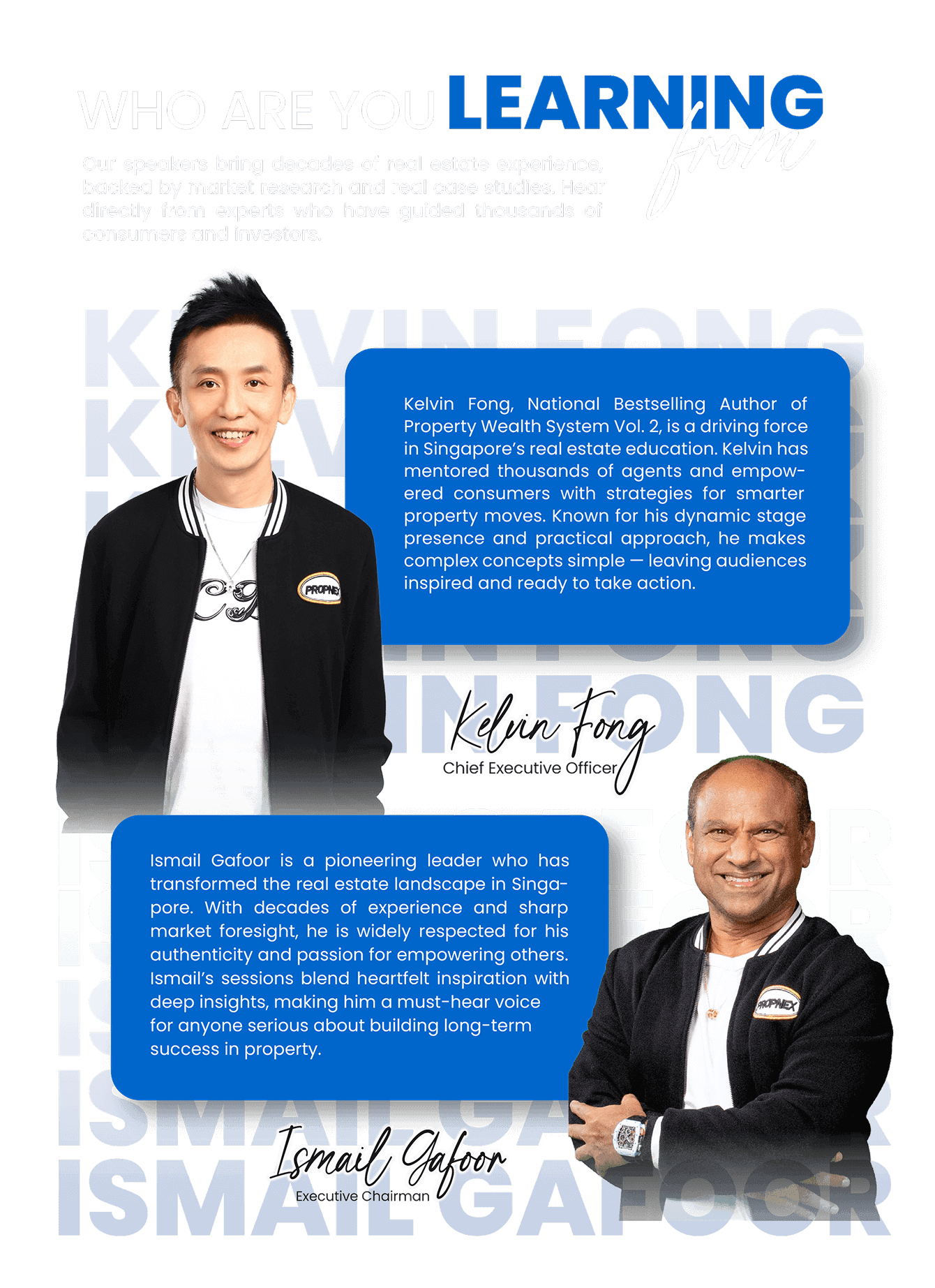

Our speakers bring decades of real estate experience, backed by market research and real case studies. Hear directly from experts who have guided thousands of consumers and investors.


01 Are these seminars free to attend?
02 Who should attend?
03Do I need prior property knowledge?
04 Can I ask questions during the seminar?
05 Is this Learning Hub only about seminars?
Frequently
Asked Questions
Deep-Dive Learning Pathways
Beyond introductory concepts, our PWS Masterclass offers a structured, hands-on approach for homeowners and investors ready to plan long-term wealth strategies.
For those who want to go deeper, the Property Wealth System (PWS) Masterclass is a 2-day immersive workshop where you’ll:
Apply the same frameworks you learned at CES in a hands-on way
Learn to calculate and assess your own property portfolio and “property health”
Build a clear, step-by-step action plan for long-term wealth creation through property
Think of CES as your starting point to understand the market — and PWS as your roadmap to take decisive action with confidence.